Archives

Categories

ISKO-UK linked data day

On 14 September I went to the ISKO-UK one day conference on Linked Data: the Future of Knowledge Organisation on the Web.  For me, this followed on from a previous Talis session on Linked Data and Libraries I attended at the British Library in June, which I found really very interesting and informative.

The ISKO conference was a lot broader in scope- it was noticed by several speakers discussing the BBC’s use of linked data that there were 22 attendees from the BBC- and  included talks about local and national government, business, libraries, as well as the Ordnance Survey. The following is a brief and personal overview, pausing in more detail over aspects that interested me more. It assumes a passing acquaintance with linked data and basic RDF.

Professor Nigel Shadbolt from the University of Southampton, a colleague of Tim Berners-Lee at Southampton as well as in advising the British Government developing the data.gov.uk site, opened with a talk about Government Linked Data: A Tipping Point for the Semantic Web. There were two interesting points from this (there were many, but you know what I mean). First was the speedy and incredible effects of openly releasing government data. Professor Shadbolt used the analogy of the mapping by John Snow of the 1854 cholera epidemic which identified a pump as the source and led to the realisation that water carried cholera. He mentioned the release of government bike accident data that was little used by the government but which was taken up and used by coders within days to produce maps of accident hotspots in London and guides to avoiding them.
The second point was the notion of the “tipping point” for the semantic web and linked data referred to in the talk’s title. Several speakers and audience members referred to the similar idea of the “killer implementation”, a killer app for the semantic web that would push it into the mainstream. The sheer quantity of data and use it is quickly put to, often beyond the imagination of those who created and initially stored it, was quite compelling. Richard Wallis made a similar point when discussing the relative position of the semantic web compared to the old-fashioned web in the 1990s. He noted that it is now becoming popular to the extent that is nearly impossible to realistically list semantic web sites and predicts that it will explode in the next year or so. Common to both Nigel Shadbolt’s and Richard Wallis’s talks was a feeling almost of evangelism: Richard Wallis explicitly refers to himself as a technology evangelist; Nigel Shadbolt referred to open government data as “a gift”. Despite being relatively long in the tooth, RDF, linked data, and all that have not yet taken off and both seemed keen to push it: when people see the benefits, it won’t fail to take off. There were interesting dissenting voices to this. Martin Hepp, who had spent over eight years coming up with the commercial GoodRelations ontology, was strongly of the opinion that it is not enough to merely convince people of the social or governmental benefits, but rather the linked data community should demonstrate that it can directly help commerce and make money. The fact that GoodRelations apparently accounts for 16% of all RDF triples in existence and is being used by corporations such as BestBuy and O’Reilly (IT publishers) seems to point to a different potential tipping point. Interestingly, Andreas Blumauer in a later talk said that SKOS (an RDF schema to be discussed in the next paragraph) could introduce Web 2.0 mechanisms to the ‘web of data’”. Perhaps, then, SKOS is the killer app for linked data (rather than government data or commercial data as suggested elsewhere), although Andreas Blumauer also agreed with Martin Hepp in saying that “If enterprises are not involved, there is no future for linked data”. In my own ignorant judgement, I would suggest government data is probably a more likely tipping point for linked data, closely followed by Martin Hepp’s commercial data. It is government data that is making people aware of linked data, and especially open data, in the first place. This is more likely to recruit and enthuse. I think the commercial data will be the one that provides the jobs based on the foregoing: it may change the web more profoundly but in ways fewer people will even notice. I suppose it all depends on how you define tipping points or killer apps, which I don’t intend to think about for much longer.

The second talk, and the start of a common theme, was about SKOS and linked data, by Antoine Isaac. This was probably the most relevant talk for librarians and was for me a simple introduction to SKOS, which seems to be an increasingly common acronym. SKOS stands for Simple Knowledge Organisation System and is designed for representing (simply) things like thesauruses* and classification schemes, based around concepts. These concepts have defined properties such as preferred name (“skos:prefLabel”), non-preferred term (“skos:altLabel”), narrower term (“skos:narrower”), broader term (“skos:broader”), and related term (“skos:related”).  The example I’ve been aware of for some time is the representation of Library of Congress Subject Headings (LCSH) in SKOS, where all the SKOS ideas I’ve just mentioned will be recognisable to a lot of librarians. In the LCSH red books, for example, preferred terms are in bold, non-preferred terms not in bold preceded by UF, and the relationships between concepts is represented by the abbreviations NT, BT, and RT. In SKOS, concepts and labels are more clearly distinct. An example of SKOS using abbreviated linked data might be (stolen and adapted from the W3C SKOS primer):

ex:animals rdf:type skos:Concept;
skos:prefLabel “animals”;
skos:altLabel “creatures”;
skos:narrower ex:mammals.

This means that ex:animals is a SKOS concept; that the preferred term for ex:animals is “animals”; a non-preferred term is “creatures”; and, that a narrower concept is ex:mammals. In a mock LCSH setting this might look something like this:

Animals
UF Creatures
NT Mammals

In the LCSH example, however, the distinction between concepts and terms is lost. One aspect of SKOS that Antoine Isaac spent some time on is the idea of equivalent concepts, especially across languages. In RDF you can bind terms to languages using an @ sign, something like this:

ex:animals rdf:type skos:Concept;
skos:prefLabel “animals”@en;
skos:prefLabel “animaux”@fr.

However, you can also link concepts more directly using skos:exactMatch, skos:closeMatch, skos:broadMatch, skos:narrowMatch, and relatedMatch to link thesauruses and schemes together. These are admittedly a bit nebulous. He mentioned work that had been done on linking LCSH to the French Rameau and from there to the German subject thesaurus SWD. For example:

Go to http://lcsubjects.org/subjects/sh85005249 which is the LCSH linked data page for “Animals”. (You can view the raw SKOS RDF using the links at the top right, although sadly not in n3 or turtle format which I have used above). At the bottom of the page there are links to “similar concepts” in other vocabularies, in this case Rameau.
Go the the first one, http://stitch.cs.vu.nl/vocabularies/rameau/ark:/12148/cb119328694, and you see the Rameau linked data page for “Animaux”.

In the LCSH RDF you can pick out the following RDF/XML triples:

<rdf:Description rdf:about=”http://lcsubjects.org/subjects/sh85005249#concept”>
<rdf:type rdf:resource=”http://www.w3.org/2004/02/skos/core#Concept”/>
<skos:prefLabel>Animals</skos:prefLabel>
<skos:altLabel xml:lang=”en”>Beasts</skos:altLabel>
<skos:narrower rdf:resource=”http://lcsubjects.org/subjects/sh95005559#concept”/>
<skos:closeMatch rdf:resource=”http://stitch.cs.vu.nl/vocabularies/rameau/ark:/12148/cb119328694″/>

which is basically saying the same as (clipping the URIs for the sake of clarity):

lcsh:sh85005249#concept rdf:type skos:Concept;
skos:prefLabel “Animals”@en;
skos:altLabel “Beasts”@en;
skos:narrower lcsh:sh95005559#concept;
skos:closeMatch rameau:cb119328694.

Not too far from the first example I gave, with the addition of  a mapping to a totally different scheme. Or in mock red book format again but with unrepresentable information missing:

Animals
UF Beasts
NT Food animals

Oh that some mapping like this were available to link LCSH and MeSH…!

Several other talks touched on SKOS, such is its impact on knowledge management. Andreas Blumauer talked about it in demonstrating a service provided by punkt. netServices, called PoolParty.** I don’t want to go into depth about it, but it seemed to offer a very quick and easy way to manage a thesaurus of terms without having to deal directly with SKOS or RDF. During the talk, Andraeas Blumauer briefly showed us an ontology based around breweries, then asked for suggestions for local breweries. Consequently, he added information for Fullers and published it right away. To see linked data actually being created and published (if not hand-crafted) was certainly unusual and refreshing. Most of what I’ve read and seen has talked about converting large amounts of data from other sources, such as MARC records, EAD records, Excel files, Access databases, or Wikipedia. I’ve had a go at hand-coding RDF myself, which I intend to write about if/when I ever get this post finished.

I don’t want to go into detail too much about it***, but another SKOS-related talk was the final one from Bernard Vatant who drew on his experience in a multi-national situation in Europe to promote the need for systems such as SKOS to deal more rigorously with terms, as opposed to concepts. Although SKOS would appear to be about terms, in many ways it is not clear on many matters of context. For instance, using skos:altLabel “Beasts” for the concept of Animals as in the examples given above gives no real idea of what the context of the term is. Here is a theoretical made-up example of some potential altLabels for the concept of Animals which I think makes some of the right points:

Animal (a singular)
Beasts (synonym)
Animaux (French term)
Animalia (scientific taxonomic term)

These could all be UF or altLabels but using UF or altLabel gives no idea about the relationship between the terms, and why one term is a non-preferred term. He gave another instance of where this might be important in a multinational and multilingual context, where the rather blunt instrument of adding @en or @fr is not enough, when a term is different in Belgian, French, or Canadian varieties of French. This has obvious parallels in English, where we often bemoan the use of American terms in LCSH. Whether embedded in LCSH or as a separate list, it might be possible to better tailor the catalogue for local conditions if non-preferred terms were given some context. Perhaps “Cellular telephones” could be chosen by a computer to be displayed in a US context, but “mobile telephones” could be chosen in a UK context if the context of those terms were known and specified in the thesaurus.

Moving away from SKOS, Andy Powell talked about the Dublin Core Metadata Initiative (DCMI). I’ll admit I’ve always been slightly confused as to what the precise purpose of Dublic Core (DC) is and how one should go about using it. Andy Powell’s talk explained a lot of this confusion by detailing how much DC had changed and reshaped itself over the years. To be honest, in many ways I found it surprising how it is still active and relevant given the summary I heard. The most interesting part of his talk for me was his description of the mistakes or limitations of the DCMI caused by its library heritage. Another confession- my notes here are awful- but the most important point that stuck out for me was the library use of a record-centric approach, e.g.:

  • each book needs a self-contained record
  • this record has all the details of the author, title, etc.
  • this record is used to ship the record from A to B (e.g. from bibliographic utility to library catalogue),
  • this record also tracks the provenance of the data within the record, such as within the 040 field: it all moves together as one unit.

Contrast this with the sematic web approach where data is carried in triples. A ‘record’, such as an RDF file, might only contain a sameAs triple which relates data about a thing to a data store elsewhere; many triples from multiple sources could be merged together and information about a thing could be enriched or added to. This kind of merging is not particularly easy or encouraged by MARC records (although the RLUK database does something similar and quite tortuously when it deduplicates records). There’s a useful summary of all this at all things cataloged which opens thus:

Despite recent efforts by libraries to release metadata as linked data, library records are still perceived as monolithic entities by many librarians. In order to open library data up to the web and to other communities, though, records should be seen as collections of chunks of data that can be separated / parsed out and modeled. Granted, the way we catalog at the moment makes us hold on to the idea of a “record” because this is how current systems represent metadata to us both on the back- and front-end. However with a bit of abstraction we can see that a library record is essentially nothing but a set of pieces of data.

One problem with the linked data approach though is the issue of provenance which was referred to above as one of the roles the MARC record undertakes (ask OCLC, e.g. http://community.oclc.org/metalogue/archives/2008/11/notes-on-oclcs-updated-record.html). If you take a triple out of its original context or host, how can you tell who created the triple? Is it important? Richard Wallis always makes the point that triples are merely statements: like other web content they are not necessarily true at all. Some uneasiness on the trustworthiness or quality of data turned up at various points during the day. I think it is an interesting issue, not that I know what the answer is, especially when current cataloguing practices largely rely on double checking work that has already been done by other institutions because that work cannot really be trusted. There are other issues and possible solutions that are a little outside my comfort zone at the moment, including excellent buzzwords like named graphs and bounded graphs.

Andy Powell also mentioned, among other things:

  • the “broad semantics” or “fuzzy buckets” of DC which derive in large part from the library catalogue card, where, for instance, “title” or “creator” can mean all sorts of imprecise things;
  • flat world modelling where two records are needed to describe say, a painting and a digital image of the painting. This sounds to me like the kind of thing RDA/FRBR is attempting (awkwardly in my view) to deal with.
  • the use of strings instead of things, such as describing an author as “Shakespeare, William” rather than <http://www.example/authors/data/williamshakespeare>. This mirrors one of the bizarre features of library catalogues where authorities matching is generally done by matching exact strings of characters rather than identifiers. See Karen Coyle for an overview of the headaches involved.

There were three other talks which I don’t propose to go into in much detail. I’ve touched on Richard Wallis’s excellent (and enthusiastic) introduction to the whole idea of linked data and RDF, a version of which I found dangerously intriguing at a previous event given by Talis. He talked about, among other things, the use of the BBC in using linked data to power its wildlife pages (including drawing content from Wikipedia) and World Cup 2010 site; in fact, how linked data is making the BBC look at the whole way it thinks about data.

His other big message for me was to compare the take-up of the web to where the current take of linked data was in order to suggest that we are on the cusp of something big: see above for my discussion of the tipping point.

* I don’t like self-conscious classical plurals where I can help it, not that there’s anything wrong with them as such.
** I can’t help but find this name a little odd, if not actually quite camp. I expect there’s some pun or reference I’m not getting. Anyway. Incidentally, finding information about PoolParty from the punkt. website is not easy, which I find hard to understand given that it is a company wanting to promote its products; and, more specifically, it is a knowledge management (and therefore also information retrieval) company.
*** Partly because I don’t think I could do it justice, partly also because it was the most intellectual talk and took place at the end of the day.

Crazy Elephant (chess variant)

As I mentioned in a previous post, I have been playing a lot of correspondence chess over the last couple years at SchemingMind.com. One of the great things about SchemingMind is the range of chess variants you can play there. Indeed, as I mentioned in the previous post, I first joined the site in order to try playing Shatranj, the medieval predecessor of modern chess. However, you can also discuss and request established or newly invented variants for inclusion on the site. Of course, a lot depends on technical considerations (e.g. only games played on an 8×8 board are currently available), the time needed to programme and set them up, or the playability of the game itself.

One idea I came up with was Crazy Elephant. Like a lot of variants, this didn’t take a whole load of original thought but is instead a blend of two other variants, in this case one ancient and one modern. The first variant is Shatranj, as mentioned above. This is often seen as slow, especially in the opening: the reforms that transformed it into modern chess largely address this one criticism: bishops instead of the two-square-jumping elephants; the queens with combined rook+bishop movement instead of the limited fers moving only one-square diagonally; the initial two-square pawn move, etc. The elephant in particular can seem especially weak as it can only move to 1/8 of the squares of the board.

The other variant is Crazyhouse, a one player version of a more established game called Bughouse. In this game, pieces that are captured can be dropped back onto the board by the capturing player as their own. It is also sometimes called Chessgi in allusion to the Japanese variation on chess, Shogi, which has a similar rule. By contrast with Shatranj, this is often seen as aggressive, if not too much so. Knights are particularly valuable in Crazyhouse as they can be dropped into crowded positions and cannot be defended against by dropping a piece to block them.

I’d always wondered what some of the modern chess variants would be like if the principles underlying them were transferred to some of the historical (e.g. Shatranj) or regional (e.g. Makruk) variants. I thought a combination of Shatranj and Crazyhouse in particular might work well because there are two jumping pieces in Shatranj: the knight and the elephant. The drops also give the restricted elephant scope to appear anywhere on the board. Having played the game, the opening is also a lot sharper than Shatranj, partly due to the power of dropped pawns on the 7th rank which is a lot weaker in Shatranj than standard chess: as soon as one pawn is exchanged the whole board is essentially open. I like to think Crazy Elephant sharpens Shatranj and tames Crazyhouse.

Austin, who runs SchemingMind, kindly agreed to set the game up on the site and after a test tournament, it is now one of the regularly played variants on there. I prepared a description for the site with rules etc., and amended it for submission to the the Chess Variants Pages site, although they haven’t added it yet for whatever reason. The amended version, without images and with a few other minor tweaks, is given below:

Crazy Elephant

Introduction

Crazy Elephant is a variant of Shatranj where players can drop captured pieces as in CrazyHouse. This variant was invented by Thomas Meehan and was implemented at SchemingMind.com in December 2009.

Setup

The initial setup of the board is identical to standard chess, with with Alfils (elephants) replacing Bishops and the Firzan replacing the Queen. The King always starts on the e file with the Firzan on the d file. This is unlike Shatranj where the position of the King and Firzan are interchangeable as long as the two Kings face eachother.

Pieces

Like Shatranj, Crazy Elephant is played with a slightly different set of pieces to standard chess, in particular with Alfils (elephants) replacing Bishops and Firzans replacing Queens:

  • Shah (king) moves as in standard chess
  • Rukh (rook) moves as in standard chess
  • Faras (knight) moves as in standard chess
  • Baidaq (pawn) moves as in standard chess
  • Firzan (queen) moves to the first diagonal square
  • Alfil (elephant, bishop) leaps to the second diagonal square, never occupying the first diagonal

Rules

The rules of Crazy Elephant are similar to standard chess, with the following exceptions:

Movement

  • There is no initial two-step Pawn move
  • There is no en passant capture option
  • There is no castling option

Promotion

  • Pawns arriving at the last rank always promote to Firzans

Winning and Drawing

  • Stalemate counts as a win
  • Bare King counts as a win, provided that your King cannot be bared on the very next move
  • Two bare Kings count as a draw

Dropping Captured Pieces

  • Pieces you capture become yours to use as you wish on a future turn (and vice versa for your opponent). You can “drop” them anywhere on the board including checking the King. Pawns cannot be dropped on the 1st or 8th rank, and if a promoted pawn is captured, it reverts back to a Pawn.

Notes

The bare kings rules can produce unexpected results for those familiar with Crazyhouse.

Playing Tips

Play is generally quicker than Shatranj but slower than CrazyHouse. Winning attacks take longer to plan and execute than CrazyHouse, hindered by the generally less powerful pieces but aided by the inability of the opponent’s King to castle into protection.

Alfils are more powerful than in Shatranj. As they can jump, they can act like knights in CrazyHouse which can force a king to move when checked.

Be aware of forks from dropped pawns, especially on the 2nd and 7th ranks. Squares b2, g2, b7, and g7 are particularly susceptible to attack if the appropriate Rook and Alfil have not moved; if the Knight between them and the pawn in front of the Rook has not moved, then the Rook can be easily lost with no compensation.

Computer Play

You can play Crazy Elephant on the online correspondence chess site SchemingMind.com

Sample Game

The @ symbol is used to denote drops, as is conventional in CrazyHouse:

1. c3 e6 2. f3 d6 3. d3 d5 4. c4 dxc4 5. dxc4 Ba6 6. c5 Nd7 7. P@d4 Bh6 8. Nd2 Bf4 9. Ne4 Ngf6 10. e3 Bh6 11. Ba3 Nxe4 12. fxe4 Nf6 13. e5 Nd5 14. Qe2 Nxe3 15. Rc1 Nxg2+ 16. Kf2 Nf4 17. Nh3 Nxh3+ 18. Bxh3 N@c4 19. b3 Nxa3 20. Rhg1 Rg8 21. N@h5 N@f4 22. Rxg7 Rxg7 23. Nxg7+ Kf8 24. P@f6 Nxh3+ 25. Kg3 Kg8 26. R@e8+ B@f8 27. Kxh3 c6 28. N@c7 Rc8 29. Ncxe6 fxe6 30. Rxe6 N@f4+ 31. Kg4 Nxe6 32. Kh5 Nxg7+ 33. fxg7 Kxg7 34. P@f6+ Kf7 35. N@g5+ Ke8 36. P@e6 N@f4+ 37. Kg4 P@f5+ 38. Kf3 P@e4+ 39. Ke3 Nd5+ 40. Kf2 P@e3+ 41. Kg3 P@f4+ 42. Kg2 R@f2+ 43. Kh3 Rxh2+ 44. Kxh2 P@g3+ 45. Kg1 Qe7 46. f7+ Kd8 47. R@d7#

I should also point out that I’m very good at it though.

Royal scandals are not what they were

If you ever think the current British royal family is prone to scandal, how about this one from the 1660s as told by Samuel Pepys in his diary. It involves the future King James II, who in 1668 was the Duke of York and heir to the throne. I don’t think Diana, Charles, Philip, or Fergie quite had this to deal with:

[6 April 1668] …whither came my Lady Kerneagy, of whom Creed tells me more perticularly: how her Lord, finding her and the Duke of York at the King’s first coming in too kind, did get it out of her that he did dishonour him; and so he bid her continue to let him, and himself went to the foulest whore he could find, that he might get the pox; and did, and did give his wife it on purpose, that she (and he persuaded and threatened her that she should) give it the Duke of York; which she did, and he did give it to the Duchesse; and since, all her children are thus sickly and infirm- which is the most pernicious and foul piece of revenge that I ever heard of. And he at this day owns it with great glory, and looks upon the Duke of York and the world with great content in the ampleness of his revenge.

(Pepys, Samuel. The diary of Samuel Pepys : a selection / selected and edited by Robert Latham. London : Penguin, 2003. 9780141439938 p. 901-902.)

A note on people:

  • “Lady Kerneagy” is Lady Carnegie
  • “her Lord” is her husband, Lord Carnegie
  • The Duke of York is the heir to the throne and the future King James II
  • the “Duchesse” is his wife, the Duchess of York
  • The King is Charles II whose “coming in” is the Restoration of 1660
  • John Creed is an acquaintance of Pepys who worked for the same patron

BBC News

The  BBC News website was silly enough to ask my opinion of their site earlier today. I couldn’t let that opportunity go, so filled in the survey, including the following two questions:

Q. 
A. It is relatively unbiased and it is ad-free. I trust its intentions if not its facts.
The RSS feeds. I find a local one useful.


A. – It’s trying to be a magazine as well as a news site. Like BBC Breakfast, it can’t effectively do both. As a non-profit site, it can be different and deliver quality and untainted news, if it wants.
- Much of the journalism seems lazy. I don’t believe facts are adequately checked; too much reliance is still placed on official hand-outs or from other news agencies: I believe the BBC has loads of local and international correspondents, but I don’t believe these are used efficiently; obvious questions are often neglected in stories.
- Much of the editing is similarly lazy, with obvious typos and grammar errors incredibly common. Although I appreciate the BBC wants to get news out fast, few of its articles are so long that they couldn’t be read at least once over, perhaps by an editor.
- The new layout is awful. I could always see the headlines on one page with no scrolling before. Now I am bombarded by the big story and have to scroll down all the time. I’m happy with a list of top stories without you having to pick the top one for me to the exclusion of the others. The top now has so many menus and buttons that it is effectively noise and the design of the masthead just looks like it hasn’t rendered properly. More concretely, the most watched/listened bit doesn’t fit on my Firefox and cover up the most shared item, which looks somewhat naff.
- I don’t generally want to watch video, so the media players starting all the time slow down page loads and lead me to content I can’t (at work) or don’t want to access.

For the first time in about ten years, I am looking round for another news site.

It’s probably rushed, ill thought out and not all based on facts, but I’m sure they’re used to that. I’ll admit that I corrected one major typo above which didn’t make sense.

CILIP (not) on Newsnight

I understand that CILIP was actually offered a chance to talk on Newsnight the other day. I’ve always been of the opinion that CILIP should make more effort to push itself into the media, to publicise and stand-up for the profession. The other day the BBC actually asked CILIP onto a programme, and a significant and highly influential one at that, and they didn’t have anyone available. I expect there are real and genuine reasons why there wasn’t anyone- apparently there were people willing to speak by phone or video link- but I think the fact that CILIP was not prepared for such an occasion, even when libraries were unusually in the news that day, is very symbolic of CILIP’s attitude and institutional inability to promote the profession and to deal with modern media. This is especially surprising given all the recent soul-searching within CILIP and the recognised urgent need for the library profession to defend itself as it’s a soft target in any upcoming cuts. Any robust response to the now infamous KPMG report (see p. 19) seems to have consisted of unofficial bloggers (e.g.) and bloggers from CILIP Update (e.g.), all largely preaching to the choir. I hope they were also pushing a press release down the BBC’s throat, although I haven’t heard of one.

Update:  I should point out that, according to the thewikiman,  CILIP apparently asked to be on Newsnight in the first place:

I now understand that in fact CILIP contacted Newsnight in the first place – although they ultimately couldn’t make it happen. For me, even though the end result is the same, there’s a huge difference between those two scenarios – in one, CILIP is shirking a fabulous opportunity, but in the other (in actuality) they were tryng to MAKE an opportunity offf their own proactiveness… Which is great. Shame, obviously, that it didn’t work out, and I stand by the idea that hevean and earth should be moved in such a scenario, but the most important thing to take from this new understanding of the events is that it shows CILIP is already moving in the right direction.

I have to agree with that.

Eurovision 2010: post mortem of the United Kingdom entry

Just before the results started to be announced during Saturday’s Eurovision Song Contest, I made a couple of predictions:

I wonder if Greece might be a good compromise candidate. I’ll say Greece. Possibly Germany. Null points could well go the UK- sadly the performance was weak- I know Josh could do it better, but we still wouldn’t deserve it. I think France are possibles. Russia would be too if it wasn’t for all the bloc voting.

Although I got Greece wrong (they came 8th), I was almost right in going for Germany and was on the money with the United Kingdom coming last, which was depressing. Below is my view of what went wrong (all Facts are from the various excellent Wikipedia entries):

Song. The song was a weak example of a Rick Astley song from over 20 years ago. Although Eurovision has traditionally been behind the times, it has rarely been twenty years behind. What depressed me most about the song was the backing soundtrack which really was stock Stock Aitken and Waterman. Perhaps that’s all we should have expected, but I thought Mr Waterman might at least have been able to come up with a tune and updated the backing. The song basically had nothing to make it stand out, either in terms of stupid gimmicks or the way the song was put together. The 2009 and 2010 winners could both be characterised as quirky and interesting but by no means loony, fairly traditional but still contemporary: this year’s German winner was even number 1 across Europe. Maybe if Kylie Minogue had been singing one of Pete Waterman’s songs it would have made sense, but then even she has moved on since the days of Charlene and Scott: Can’t Get You Out Of My Head might have won, although even that is getting on a bit now; I Should Be So Lucky wouldn’t have been so lucky. Back to the trains, Pete!

Performance. Sadly Josh’s performance was not the best, which was a real shame. This has happened before with United Kingdom entries and I’m not sure if it’s just bad luck, nerves (the same as England’s penalty shoot-out syndrome), or the fact that one feels more acutely the weaknesses of something you are supporting. Perhaps someone with a good deal of stage experience is needed, especially as the stages are generally competitively huge recently.

Staging. There is also something about the way the United Kingdom stages its acts which is somehow lacking. So many of the good acts seem to have a real presence and fill the screen. The last three winners make the point. They seem to fall into one of two categories: the small intimate acts and the larger more ostentatious or flamboyant ones. Russia in 2008 with the mad skater on an impossibly small rink made a so-so song quite compelling; Norway in 2009 had a larger set with movement and interest; Germany in 2010 was in theory suicidal: a small singer with dark hair on a large dark stage wearing largely black with not much in the way of backing singers or dancers. But it worked because the camera focussed on her and she filled the screen and was suitably bubbly and attractive enough to make that a good thing, even though her performance was not actually as good as it could have been (I think she looked uncomfortable in high heels and, judging from her embarrassing half-way point interviews, quite nervous). One of the other lamer entries for 2010 (I forget which) also featured a male singer, but the staging was simple and the camera was mainly filled with him so you knew what was what. However, the United Kingdom entry was too flashy (with all the big squares and ladies with cloaks) for Josh to be the focus of it, yet not nearly interesting enough (compare with Turkey which had The Stig’s wife and the Ankara branch of Kwik Fit all flouting fire and health & safety regulations) to stand out from the rest. The cubes and cloaks seemed to be merely a sop to the idea that “we need to do this kind of thing” without thinking it through or really going for it. Ideally, we need something like Lordi where the song, artist, and an eye-catching show are bound together from the start and where all three elements suit and complement each other rather than being bolted together as an after-thought.

Geopolitics. In 2004-2008, Eastern European countries achieved 3 out of 5 first places and 4 out of 5 second places; 3 of the 7 top two places went to Ukraine, and 2 to Russia, the two most powerful and best-placed countries to benefit from bloc voting. Norway’s win in the 2009 Contest demonstrated that geopolitics and bloc voting could be overcome. It also showed that ill will towards the United Kingdom because of the Iraq War, language-dominance, or whatever, was no longer an excuse, as Jade Ewen came in 5th. However, the United Kingdom does have no natural allies to at least scrape them off the bottom: I can’t see Ukraine, Greece, or Cyprus ever getting less than 12 points. Portugal and Spain always throw each other something. Although this level of support is not necessarily going to guarantee victory- Cyprus has never won- it is certainly a good bedrock on which to build: in 2010 Russia still came 11th with 90 points despite a woeful song, with the help of 12’s from neighbours Moldova, Estonia, and Belarus, a 10 from neighbour Latvia, and an 8 from neighbour Poland. We haven’t got any decent marks from Malta in recent years and we seem to doggedly hang onto the idea that Ireland are our natural friends. Interestingly, Andrew Lloyd-Webber’s attempt, at least as televised, seemed to involve a great deal of pre-contest publicity, including a surreal interview with Vladimir Putin; this, and the pre-contest splash made by Germany’s entry this year, would suggest that some kind of international effort before the contest even starts is probably a good idea, replacing static alliances with dynamic diplomacy and publicity.

What next? I think the problems basically revolve around selection. I agree with Nick: we need electoral reform. On the one hand we need wisdom from someone who understands the necessary balance between song, performer, showmanship, publicity, and politics; on the other we need something that has a broad mandate as we can’t really give up the public selection now we’ve started. The problem is that, like the British electoral system, the current public selection show is way out of date. It was radical to be given a choice in the late 1980s but since then little has changed in the format, which is still normally one show or a couple of shows over a few weeks with many decisions, such as song or composer, completely taken out of the viewers’ hands. Compare this with what is really possible through the X-Factor and its various clones. These make real stars and sell real records. They create the buzz and publicity I referred to above. They also test the mettle of the stars we send, their genuine popularity, and their appeal on a big stage on a small screen; they also give the performer some practice doing exactly what they’ll doing in the Eurovision final. Something like that would be a better outlet for the BBC’s talent show department than advertising Andrew Lloyd-Webber’s latest restaging of some ancient classic musical. It would promote talent that appeals to the contemporary taste. It is also precisely what Germany did for the 2010 competition, and they won.

Thoughts on Eurovision 2010

A good year, although some good songs, especially the Dutch entry, didn’t make the final.

Anyway, my vote goes for Germany. My anti-vote goes to Israel: it was better performed than the semi-final but still makes me want to wince. I would also like to see Turkey and Greece do well, and Serbia.

I find this one a hard one to predict. I have a horrible feeling Ireland are going to well but I can’t really see them winning. I wonder if Greece might be a good compromise candidate. I’ll say Greece. Possibly Germany. Null points could well go the UK- sadly the performance was weak- I know Josh could do it better, but we still wouldn’t deserve it. I think France are possibles. Russia would be too if it wasn’t for all the bloc voting.

Phil Bradley on CILIP in 2020

Phil Bradley has written a long “a stream of thought” post on how he would like to see CILIP looking in ten years’ time. I’m not sure how much I agree with a lot of it, but it is interesting and very positive nonetheless. What struck me (perhaps because I do agree with them) are the following couple of points:

I want information professionals to be able to look at what CILIP does and say to their employers – this is what my professional organization is doing – why can’t I do it as well?

I don’t think it is CILIP’s job to  just lead on technology (later on he gives an example of CILIP having something like an iPad that members could have a chance to play with)  or web design as this is getting beyond the remit of librarianship. Although those areas are vital I think one of CILIP’s weaknesses in fact is that it is in many respects a vanilla professional institute which, in moving away from some core of specific skills, is leaving us with nothing special to sell. For instance, trying to take ownership of the word Information rather than the word Library is dangerous as there are others, particularly computer scientists, who already own much of that ground, and have broken much of it too. Perhaps this is what Phil Bradley is driving at when he says,

I want librarians, backed by the professional body, to be the ones telling the technical staff what they should be doing, not the other way around.

However, I think that he talking about the role of librarians within an organisation rather than the acquirement of real technical skills that could increase our ability to adapt and increase our services.

Anyway, I do think it is important that CILIP leads the way as an example to its own community as well as a something to be pointed out to others as Phil Bradley suggests, something it certainly hasn’t done in the past.

I heartily agree with the following sentiment:

I want to see CILIP mentioned in the press and the media every single time there’s reference to a library, for good or ill. CILIP needs to be the organisation that’s pulled onto programmes to talk on behalf of the profession.

I think this is a must. Other issue-specific organisations are on the telly or pop up in newspapers quite often. I think if CILIP proactively offered its services and made a hue and cry on an issue, programmes like BBC Breakfast would probably listen. Incidentally, this is one area where I think changing the name from Library Association to CILIP was catastrophic: lots of people outside the profession knew the Library Association and its name is fairly self-explanatory; I don’t think the same could be said of CILIP, and I expect many people would still be mystified when the acronym is expanded.

In one other point I don’t think Phil Bradley goes far enough:

I want CILIP to continue to run courses, and I want those courses to be held, not just in London, but at your desk, with webinars, conference calling/training and so on. Why should it be necessary for me to come to London in order to sit in and watch a council meeting? Why can’t I do it at my desk?

I want those courses to be overhauled and more specific. In particular the monlithic MA needs to be ditched, a series of specific short courses needs to be introduced, and the CILIP courses on offer need to go beyond “An introduction to…”.

Photos of me

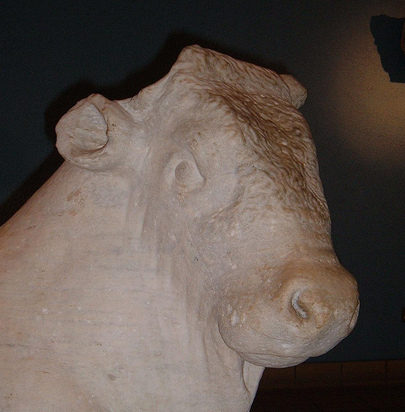
I expect most readers of this blog are desperate to know what I really look like. The photo at the top of this blog doesn’t really give a good image so I put some better pictures on Flickr, the most representative of which is below:

Orangeaurochs

Orangeaurochs

The caption reads:

Marble figure of a recumbent bull

Probably made in Athens about 400-350 BC. Perhaps from Kerameikos, Athens.

The bull may have served as a grave marker; it is likely that it was designed to be set on a high base and so seen only from below and from the front.

According to Wikipedia, Kerameikos is an area of Athens famous for its potters (the name is related to our word ceramic) as well being the site of a significant cemetery. Presumably the recumbent bull did some service there.

General Election prediction

Following my highly acclaimed* and wildly popular** predictions of Eurovision results, I offer my l33t sybilline skilz to the 2010 General Election tomorrow. All free of charge***:

The Conservatives will scrape a majority.

This is based on the principles that both the Liberal Democrat and Labour support will ebb away just enough and that David Cameron’s eyebrows have done a good job of looking serious while he says the word “values”**** a lot over the last week or so.

This is not to say that I hope it will happen. I hope the following happens, which is a little more complicated:

A hung Parliament with Labour the 2nd largest party: Labour form a government with the Liberal Democrats at least just long enough to enact proportional representation so that, whenever the coalition collapses (as it very shortly will, especially if Labour have to go through the rigmarole of appointing a new leader, which is likely as a condition of coalition in the first place) the Liberal Democrats have a serious shot at power in the next election or at least of heavily outflanking the Conservatives in a future coalition.

I think the Liberal Democrats would be foolish to enter a coalition with the Conservatives as they won’t get proportional representation with them, and they will then recede back into obscurity once the effect of the first TV debate fades and David Cameron’s eyebrows become yet more serious. Some of the implications of a Liberal/Conservative coalition are also quite dangerous. The Liberal Democrats, for instance, favour a referendum on membership of the European Union rather than, say, just membership of the Eurozone or closer integration. I don’t think membership of the EU is something that is even an issue anymore. Although they put a positive slant on it

Liberal Democrats have argued for a referendum on whether Britain stays in or leaves the EU. We are the only party confident enough to put the pro-European case to the British people on the big issue facing us – and let the people decide. Britain will only win the case for a flexible, democratic Europe in Brussels if we settle our arguments at home on whether we should be part of the EU or not.

…I fear what could happen in straightened times and in concert with a Conservative government. I am not as confident as the Liberal Democrats.

Anyway, this is by the by. More importantly, William Hill are running a book. As I write, the predictions are:

  • No overall winner: 4/7
  • Conservative majority: 6/4
  • Labour majority: 16/1

Interestingly, William Hill are also offering odds for the individual constituencies. For Bedfordshire North East the odds are:

  • Conservative: 1/500
  • Labour: 33/1
  • Liberal Democrat: 33/1

Normally, you’d say you’d bet your house on the Conservatives winning this one, but for 1/500 it’s hardly worth the hassle. No prices for UKIP or the BNP I see.

* I did correctly predict the 2007 result.

** Perhaps not.

*** I.e. not for prophet.

**** Sounds a lot like the equally meaningless and equally riding-for-a-fall mantra “back to basics” that John Major had introduced following his affair with Edwina Currie.